
You don’t need to be a Physiotherapist to bear witness to how incredible the human body is.
If you haven’t seen some remarkable physical feat or transformation on Instagram then you’ve probably read a David Goggins book or the like. The ability to become anything you want with the right input and dedication is being constantly demonstrated to us, so much so, we can be excused for taking it for granted.
It may sound very obvious to state this but one thing that separates us from machines (and that is fundamental to all organisms) is the ability to ‘adapt’. Adaptation, at a general level, allows organisms to survive happily in their environment and enhance their ability to reproduce. At a musculoskeletal level, it involves the ability to change our functional capacity through the stresses we impose upon ourselves (eg. training). You’ve heard the saying, “you are what you eat”? Well the same thing could be said, “you are what you do”.
Examples:
- If you weight train (resistance training), the musculoskeletal system will respond. The type of resistance, the speed and dosage will impact the result. Using resistance to train for power (speed + load) is quite different to training for hypertrophy. Both Powerlifters and Bodybuilders do resistance training, but both look very different and have different resultant capabilities and competencies.
- If you run for ‘fitness’, your ‘fitness’ improves. Running evokes a response from multiple systems. Your heart muscle can grow, improving stroke volume and reducing heart rate. The oxygen carrying capacity of the blood improves. Your tendons become more tolerant to repeated stretch/shortening. Your bones become more dense and resistant to impact loading forces. The list goes on….
This basic concept is very important to remind ourselves of, because in reality there is a fine line between an ‘appropriate’ amount of stimulus to evoke a desirable response and too much or too little to have a deleterious one. This is the dance you all do every day with your own training programs and that we, as Physio’s, ultimately help you navigate to stay ‘on track’ and remain injury free.
In a nutshell, injury and adaptation exist on the same continuum. Whether it be degenerative or traumatic injury, the biomechanical stimulus that essentially governs the responses are the same – load.
A very basic concept that I recall reading as a young student Physio that had a particularly profound effect on me was the idea of ‘use’. In particular, the effect varying amounts of ‘use’ (or externally applied ‘load’) has on biological tissues.
- Dis-use: No to minimal loading stimulus on the tissue to maintain its material strength.
- Mis-use: Tissue not used for intended purpose relative to its material quality.
- Over-use: Repeated excessive tissue overload causing intrasubstance micro-failure.
- Ab-use: High force, abrupt loads beyond the tissues capacity to withstand causing it to fail eg. ACL rupture.
The ‘Sweet Spot’
The sweet spot of tissue load is the optimal range that promotes anabolic tissue adaption. Note that too much or too little load and strain actually promotes a catabolic response to tissue remodelling.
Yes, this is the full-time work of Physiologists, Biomechanists, Sports Scientists and Sports Physiotherapists in elite level sporting organisations, however, we are all made of the same material (not withstanding any underlying disease processes) and grasping this understanding is the first step in achieving ultimate training glory – maximal gains, minimal pains!
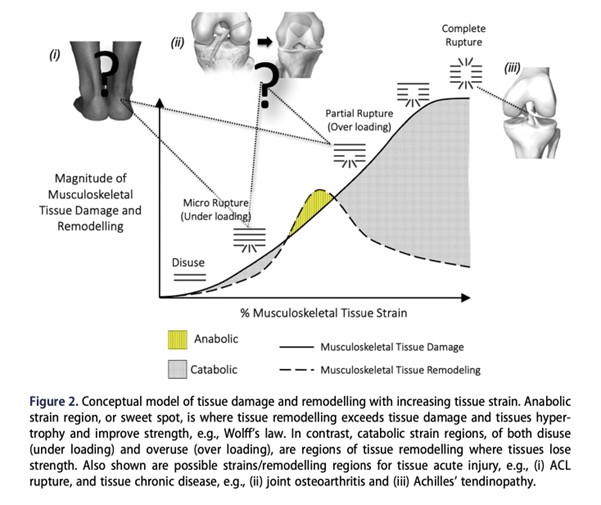
Lloyd, D. (2021). The future of in-field sports biomechanics: wearables plus modelling compute real-time in vivo tissue loading to prevent and repair musculoskeletal injuries. Sports Biomechanics, 1-29. Reproduced with permission from Author.
So what steps can you take to help you find the sweet spot?
- Use trusted sources: David Goggins ran himself in to full blown rhabdomyolosis which can cause kidney damage, even death. Be careful getting information that isn’t relevant to you, your history or training age.
- Listen to your body: Some discomfort is not unusual with many training stimuli, but prolonged or escalating discomfort is not normal. This could be a sign you’ve entered in to a catabolic tissue state. Get your niggles looked at – you might find a quick tweak to your programming is all it takes.
- Take a progressive approach to training: We are typically most ambitious at the start of a new training goal or regimen. This must be tempered with restraint in your programming. Give yourself plenty of time to reach your goals and approach it in a staged and progressive manor in order for your tissues to remodel and adapt to the changing loads. This will require you to have a plan.
- Track your performance metrics: Most professional sports teams do this weekly with their players to indicate how their current training load is impacting their functional output. Individual functional norms may take 1-3 days to return to baseline post-game. You may not have access to high-end force platforms and dynamometers (although performance equipment is becoming more affordable and available to recreational athletes) but simple measurements like a knee-to-wall (ankle range in centimetres) or hop for distance (in metres) may be simple “at home” examples to monitor range and power in the lower limb.
- If in doubt, give us a shout: Reach out to a health professional and run them through your training plans. You may get some useful training insights that lead to faster gains with less chance of injury. Prevention is always better than cure.
See you in the clinic.
Chris Dillon
APA Sport & Exercise Physiotherapist