
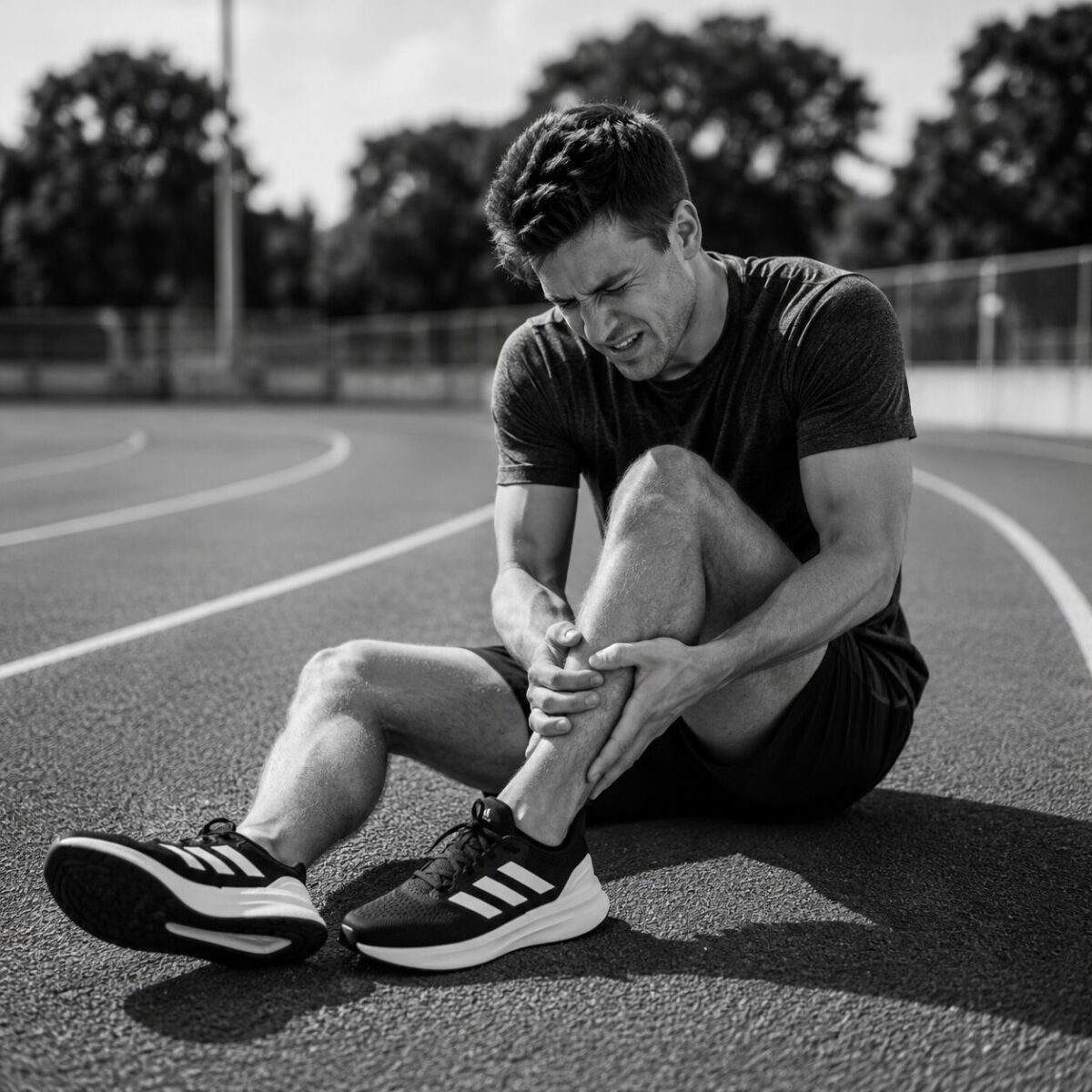
One of the most common questions we get from athletes is:
“It hurts when I train. Should I stop?”
The answer isn’t always yes.
Pain is one of the body’s most important warning systems, but it isn’t a perfect measure of tissue damage. Some pain during rehabilitation can be acceptable, while other types of pain are a clear sign that the current training load needs to change.
The difficult part is knowing the difference.
This is particularly important for athletes who are trying to maintain fitness, return from injury or prepare for an upcoming event. Completely stopping every time something hurts isn’t necessarily the best solution. But ignoring pain and simply pushing through it isn’t either.
So, when is it okay to train through pain?
And when should you back off?
Let’s work through it.
First: Pain Doesn’t Always Equal Damage
Pain is real.
But pain does not always tell us exactly what is happening inside a tissue.
The relationship between pain and tissue damage is more complicated than:
More pain = more damage
and
No pain = no damage.
Pain can be influenced by a number of factors, including:
- the amount of physical load
- previous injury
- fatigue
- stress
- sleep
- expectations
- previous experiences with pain
- the context in which the pain occurs
This is one reason why two athletes can perform exactly the same activity and have very different pain experiences.
One athlete might complete a training session with mild discomfort and feel completely normal afterwards.
Another might experience the same discomfort but develop increasing symptoms over the next 24 hours.
The pain itself is important.
But the behaviour of the pain can be even more useful.
So, Is Some Pain During Training OK?
Sometimes.
In rehabilitation, we often need to expose an injured or sensitive area to load.
If we completely avoid loading a tissue because it produces any sensation whatsoever, we can sometimes end up with a problem in the opposite direction: too little exposure and too little capacity.
Tissues need appropriate loading to adapt.
This is particularly relevant for athletes recovering from conditions involving tendons, muscles and other load-sensitive tissues.
The goal isn’t necessarily to achieve:
Zero pain → then start training.
Instead, the goal may be:
Appropriate load → manageable symptoms → recovery → adaptation → increased capacity.
But there is an important distinction here.
Acceptable pain is not the same thing as ignoring pain.
We need to monitor the response.
The 24-Hour Response
One of the simplest ways to judge whether your current training load is appropriate is to look beyond the training session itself.
Ask:
“How did it respond afterwards?”
And then:
“How did it feel the next morning?”
For example, imagine you are rehabilitating an Achilles tendon problem.
You perform a calf-loading session and experience a small amount of discomfort.
That discomfort settles shortly after the session.
Later that day, the tendon feels much the same as it did beforehand.
The next morning, you are back around your normal baseline.
That is a very different situation from:
- pain progressively increasing during the session
- significant pain afterwards
- increasing stiffness that evening
- much worse pain the following morning
- reduced ability to perform normal activities
The second response suggests that the current load may have been too much.
This is why pain during exercise should never be considered in isolation.
The response over the following hours and days gives us much more information.
A Simple Traffic-Light System
One practical way of thinking about training pain is to use a traffic-light system.
🟢 Green: Continue
Symptoms are mild and manageable.
During training:
- pain remains low
- movement remains normal
- performance doesn’t deteriorate significantly
After training:
- symptoms settle reasonably quickly
- there is no significant increase later that day
- you’re close to your normal baseline the next morning
This generally suggests that the current load is being tolerated reasonably well.
It doesn’t mean:
“The injury is fixed.”
It means:
“The body appears to be tolerating this particular exposure.”
🟠 Orange: Modify
This is the grey zone.
You notice that:
- pain is increasing during training
- movement is changing
- the session feels harder than expected
- symptoms are more noticeable afterwards
- morning stiffness or soreness is increasing
This doesn’t necessarily mean you need complete rest.
It may mean the training dose needs to change.
For example:
- reduce the distance
- reduce the intensity
- reduce the number of repetitions
- increase recovery
- change the exercise
- temporarily remove a high-load movement
This is where good load management becomes important.
🔴 Red: Stop and Assess
Some symptoms should not simply be pushed through.
Examples can include:
- sudden severe pain
- significant swelling
- a feeling of instability or giving way
- inability to bear weight
- locking
- a new traumatic injury
- rapidly worsening symptoms
- neurological symptoms such as significant numbness or weakness
These situations warrant stopping the activity and getting appropriate medical or physiotherapy assessment.
The traffic-light analogy isn’t a diagnostic tool.
It’s simply a practical way of thinking about your response to load.
The Problem With “No Pain, No Gain”
We’ve all heard it.
“No pain, no gain.”
It sounds motivating.
It also isn’t particularly useful when we’re talking about injury rehabilitation.
Training should be challenging.
Rehabilitation should progressively challenge the body.
But pain is not the goal.
The goal is adaptation.
You want to become stronger, fitter and more capable of tolerating the demands of your sport.
If increasing pain is simply being used as evidence that you’re working hard enough, you’re missing the point.
A harder session isn’t automatically a better session.
Sometimes the best rehabilitation session is the one that provides enough stimulus to create adaptation without creating excessive irritation.
Pain During Strength Training
This is an area where athletes can become particularly confused.
Imagine you have knee pain and you’re prescribed a quadriceps strengthening program.
You perform a controlled squat and notice some mild discomfort around the knee.
Does that automatically mean the exercise is damaging your knee?
No.
It may simply mean that the knee is being loaded.
The important questions are:
- How much pain?
- Does the pain remain stable?
- Does your movement change?
- How does it respond afterwards?
- How does it feel the next morning?
- Is your overall capacity improving over time?
If the exercise produces manageable symptoms and your overall response is positive, it may be an appropriate part of rehabilitation.
But if every session produces progressively worse symptoms, then the exercise dose may need to be reconsidered.
This is where individualisation becomes important.
Pain During Running
Runners often ask:
“Can I keep running if my knee hurts?”
Again, there isn’t one universal answer.
Suppose a runner normally completes 30 km per week but develops mild knee pain.
Instead of stopping everything, we might look at modifying the load.
Perhaps:
- 30 km becomes 20 km
- hills are temporarily reduced
- hard intervals are removed
- easy running is retained
- strength work is added
- the response is monitored
The runner is still exposed to running, but the dose has changed.
This can be a much more useful approach than going from full training to absolutely nothing.
However, the appropriate modification depends on the injury and individual presentation.
If symptoms continue to worsen despite sensible changes, continuing to run isn’t necessarily the answer.
Pain During Sport Is Different Again
Training in a controlled environment is one thing.
Competition is another.
A footballer may tolerate a controlled running session with mild symptoms but struggle when exposed to:
- sprinting
- acceleration
- deceleration
- cutting
- contact
- fatigue
- repeated high-intensity efforts
This is why return-to-sport rehabilitation needs to progressively reproduce the demands of the sport.
The question isn’t simply:
“Can you do the exercise?”
It’s:
“Can you tolerate the demands you’re eventually going to face?”
Pain management therefore needs to be considered alongside strength, capacity, movement and training load.
When Pain Is More Concerning
There are some situations where the “train through it” approach isn’t appropriate.
Sudden traumatic pain
If you experience a sudden injury during sport — particularly with a significant pop, immediate swelling, instability or inability to continue — don’t simply assume it is something you can train through.
Get it assessed.
Increasing pain
If pain is progressively increasing from session to session, your current training load may be exceeding your capacity.
Something needs to change.
Persistent swelling
Swelling following activity can provide useful information about how the joint is responding.
Persistent or significant swelling warrants assessment rather than simply pushing through.
Loss of function
If you’re losing the ability to perform movements you could previously do comfortably, that’s important.
Examples include:
- inability to fully bend or straighten a joint
- inability to bear weight
- significant weakness
- repeated giving way
- locking
These aren’t situations where simply “pushing through” is the answer.
Neurological symptoms
Numbness, significant weakness, altered sensation or other neurological symptoms should be assessed appropriately.
The Pain Doesn’t Always Tell You How Much You Can Load
This is where our previous discussions about training load become relevant.
Two athletes can have the same pain score but very different capacities.
Imagine two runners both report:
“My knee pain is 3/10.”
Runner A:
- runs consistently
- has good strength
- has stable symptoms
- recovers quickly
- has gradually increased training
Runner B:
- has recently returned from six months off
- has poor training consistency
- has increasing pain
- has significant fatigue
- has suddenly increased their running
The same 3/10 pain doesn’t necessarily mean the same thing.
This is why clinical decisions can’t be based on a pain number alone.
We need to consider:
Pain + capacity + load + response + context.
A Case Example: “But It Only Hurts a Little”
Let’s meet Mark.
Mark is a recreational basketball player who has developed some knee pain.
He rates it as only 2–3/10 when playing.
So he continues.
For the first few weeks, the pain is manageable.
But he notices that:
- training feels harder
- his knee is stiffer the next morning
- his recovery takes longer
- his pain is gradually increasing
- he has started avoiding certain movements
Mark’s argument is:
“It’s only a 3 out of 10.”
But the number isn’t the whole story.
The trend is changing.
His symptoms are becoming more reactive and his ability to tolerate training is declining.
That’s a sign that something needs to change.
Perhaps the training load needs to be reduced.
Perhaps his rehabilitation needs to progress.
Perhaps another factor needs to be investigated.
The important point is that we don’t simply look at the pain score.
We look at the behaviour of the pain over time.
What About Pain That Gets Better As You Warm Up?
This is another common question.
An athlete may say:
“It hurts when I start, but once I warm up, it feels fine.”
This can happen with a number of musculoskeletal conditions.
But again, feeling better during the session doesn’t automatically mean the tissue is happy with the load.
The more useful question is:
“What happens afterwards?”
If the pain disappears during the session but is significantly worse later that day or the following morning, the overall training dose may still be excessive.
This is why we need to look at the whole response, not just what happens during the first 10 minutes of exercise.
What Should You Change If Training Hurts?
If symptoms are suggesting that your current load is too high, you don’t necessarily need to stop everything.
Think about modifying the variables.
Reduce volume
Run for less time.
Perform fewer repetitions.
Reduce the number of sets.
Reduce intensity
Slow the pace.
Reduce resistance.
Avoid maximal efforts temporarily.
Reduce frequency
Instead of training five days, perhaps you need more recovery between sessions.
Change the exercise
A particular movement may be aggravating symptoms while another exercise can train the same general capacity with less irritation.
Increase recovery
Sleep, nutrition, rest days and overall stress all influence how well you tolerate training.
Build capacity
Sometimes the answer isn’t simply less load.
You also need more capacity.
Strength and conditioning can progressively increase the amount of work your body can tolerate.
The Goal Isn’t to Avoid Pain Forever
This is probably the most important point.
If you become afraid of every sensation during exercise, you can end up avoiding more and more activities.
The goal of rehabilitation isn’t to create a body that never experiences discomfort.
Athletes will sometimes experience:
- muscle soreness
- fatigue
- stiffness
- training discomfort
- occasional aches
That’s part of being physically active.
The goal is to develop the ability to distinguish normal training responses from signs that your current load isn’t being tolerated well.
That distinction takes experience.
And sometimes, it takes assessment.
So, Can You Train Through Pain?
Sometimes.
But don’t make the decision based on the pain score alone.
Consider:
How did the pain start?
What changed in your training?
Does the pain remain stable or progressively increase?
Does your movement change?
How do you feel afterwards?
How do you feel the next morning?
Is your overall capacity improving?
Are you able to progressively increase your training?
If the answers are generally positive, some level of discomfort may be compatible with continued training or rehabilitation.
If symptoms are progressively worsening, function is declining or there are concerning signs, continuing to push through isn’t the appropriate strategy.
Key Take-Aways
Pain doesn’t automatically equal damage. Pain is important, but it needs to be interpreted in context.
Don’t judge a session by pain alone. Look at what happens during the session, afterwards and the following day.
Some pain during rehabilitation can be acceptable. The key is whether the symptoms remain manageable and your overall trajectory is improving.
Watch the trend. A stable 2–3/10 symptom that is becoming less reactive is very different from a 2–3/10 symptom that is gradually becoming worse.
Modify before you necessarily stop. Volume, intensity, frequency, exercise selection and recovery can all be adjusted.
Build capacity. The long-term goal is to increase your ability to tolerate the demands of your sport.
Don’t ignore red flags. Significant trauma, swelling, instability, loss of function, neurological symptoms or rapidly worsening pain should be assessed.
Ultimately, the goal isn’t to teach athletes to train through pain.
It’s to teach them how to understand their pain, manage their load and progressively build the capacity to do more.
FAQ
Q1: Is it okay to exercise when something hurts?
Sometimes. Mild, manageable symptoms can be compatible with rehabilitation or modified training, depending on the injury and individual circumstances. The response during and after exercise is important.
Q2: How much pain is acceptable during exercise?
There isn’t one universal pain number that applies to every injury. A low pain score alone doesn’t tell us whether an activity is appropriate. Symptoms should be considered alongside function, training load and the response over the following hours and days.
Q3: Should I stop exercising if my pain gets worse?
If pain is progressively increasing during or after training, your current load may be too high. You may need to reduce the volume or intensity, change the exercise or increase recovery. Persistent or worsening symptoms should be assessed.
Q4: What is the 24-hour rule?
The 24-hour response is a practical way of monitoring how your body responds to training. If symptoms are significantly worse later that day or the following morning, it may indicate that the previous training load was too high.
Q5: Can I run with knee pain?
It depends on the cause and severity of the pain. Some runners can continue running with an appropriately modified training load, while others may need a temporary reduction or cessation of running. A sports physiotherapy assessment can help determine the appropriate approach.
Q6: Is muscle soreness the same as injury pain?
Not necessarily. Muscle soreness after unfamiliar or demanding exercise is common, but persistent, worsening or function-limiting pain should not automatically be dismissed as normal muscle soreness.
Q7: When should I see a sports physiotherapist about pain?
Consider an assessment if pain is persistent, worsening, repeatedly returning, affecting your performance or preventing you from participating in the activities you want to do. An assessment can help determine what is contributing to the symptoms and how your training should be modified.
If you’re unsure whether the pain you’re experiencing is something you can safely train through, a sports physiotherapy assessment can help you understand the relationship between your symptoms, training load and current capacity, and develop an appropriate plan for progressing your activity.
If you need help with recovery from a running injury or need assistance building a safe training plan? Book your running assessment now via the bookings page.
See you in the Clinic
Chris Dillon
Chris Dillon is a titled APA Sport and Exercise Physiotherapist and the founder of Brisbane Sports Physiotherapy. He works with athletes from grass roots to the elite level with a focus on injury prevention and load management. He is a member of the Australian Physiotherapy Association (APA) and registered healthcare provider with the national body AHPRA.