

In Part I we touched on 3 key factors to explain why novice runners get injured more often; the principles of tissue adaptation and load progression were alluded to and the disparity in running economy and mechanics of novice versus experienced runners was discussed. In Part II, we will explore the concept of load and load progression in more detail. We will demonstrate training load errors in novice athletes leading to injury as well as give you some practical advice to help track your training loads and keep them progressing safely.
If you are preparing for a half marathon or new to running in Brisbane’s trails and parks, this is essential reading.
What is Training Load?
Load is generally split in to two key components:
1️. External Load = What the athlete does
Examples:
- Distance covered (GPS)
- High-speed running
- Accelerations / decelerations
- Gym volume (sets × reps × load)
- Session duration
2️. Internal Load = How the athlete responds
This reflects the physiological and perceptual stress imposed by that work.
Examples:
- Session Rating of Perceived Exertion (sRPE)
- Heart rate
- Lactate
- HRV (indirectly)
- Psychological stress
In a nutshell, load is a combination of how much you do AND how difficult you find it and for each of these, there are several objective metrics you can use to track over time.
Internal load x external load = Training Load
Most commonly, we use the session RPE (sRPE) model derived by Carl Foster, whereby sRPE (internal load) and training minutes (external load) are used as metrics. This is because both metrics are easy to determine without the use of sensors and easiest to implement over large cohorts. In his research papers, the final product is referred to as “Arbitrary Units” (AU). So:
Internal load x external load = Training Load
sRPE x training minutes = Arbitrary Units (AU)
Example:
One number to represent training load has been derived to reflect BOTH the amount of work done AND the cost of that work for each training session.
There are two important take-aways from this table.
- One important take-away is that all activity creates stress on the body. Whilst a gym session may only involve upper body resistance, you can still quantify this ‘load exposure’ to help reflect the overall load placed on the body as well as how much stress has been placed on the neural system. For casual gym goers and for ease of calculation, I would typically only monitor ‘on-feet’ training exposures. However, for true ‘hybrid’ athletes doing a significant amount of varied interval work, probably all activities need to be considered.
- The other very important take-away, is that internal load does not equal external load; two athletes may do the same activity but each may have a very different experience of how challenging it is. This seems like a “no-brainer” concept but lets work through it anyway to reinforce the point.
Example: An experienced and novice runner go for a run. They both run at the same pace for 10 km. It takes them 1 hour (60 mins) to complete. The experienced runner rates it a 4/10 on the RPE scale whereas the novice rates it an 8!
As we’ve previously stated; internal load does not equal external load. It is much easier for the novice to accumulate workload stress than the experienced runner over a full training week, and this is important to understand when talking about injury incidence.
Understanding Injury Risk and Safe Training Loads
The relationship between training load and injury
Gabbett’s “Load Capacity Model” states that injury occurs when load exceeds the athlete’s capacity. As we just described, injury incidence is heavily related to the amount of stress applied AND an athlete’s tolerance. Research linking RPE based Training Load and injury in runners has shown that:
- Higher weekly accumulated sRPE loads occurred in the weeks when injuries developed
- Injured runners showed significantly higher workload indices (derived from RPE)
- Distance alone did not predict injury. RPE-based workload metrics did!
This suggests that internal load (perceived effort) may be more informative than just external load (distance or time). So, in practical terms, just tracking mileage isn’t that useful when it comes to injuries. In fact, current evidence suggests injury risk is more influenced by load progression patterns than absolute mileage. Understanding load concepts is key to remaining injury free and working at an appropriate capacity to facilitate protective tissue responses.
What loading patterns to avoid
1. Sudden increases in load
One of the strongest predictors of running injury is sudden increases in weekly distance or intensity. This often occurs when runners follow generic training programs found online or in apps. While these programs can be helpful, they may not account for:
- previous training history
- current fitness level
- age
- recovery capacity
- current or previous injury concerns
- your biomechanics
Two runners following the same plan may tolerate it very differently.
In very basic terms, >30% increase in mileage could be problematic. Using mileage alone, however, as we have previously stated, is not the best metric. Something that considers how hard that activity is, is the optimum, so we must use the load values (AU).
Acute workload is the weekly accumulated training load (in AU) derived from the equation above (training minutes x sRPE). Chronic workload is the 4 week average of the acute workload. Acute to Chronic Workload Ratio (ACWR) is the latest acute load week value relative to the previous 4 weeks (chronic workload).
ACWR:
- <0.8 = potential undertraining
- 0.8 – 1.3 = sweet spot
- > 1.3 = potential overtraining
Example:
Runner A (experienced)
Week 1: 3200 AU
Week 2: 3500 AU
Week 3: 3800 AU
Week 4: 3600 AU
Week 5: 3950 AU
- Each week represents an Acute Workload.
- The 4 week average represents the Chronic Workload (3200 + 3500 + 3800 + 3600 / 4 = 3525 AU).
- The Acute to Chronic Workload Ratio (ACWR) = latest acute workload / chronic workload; 3950 / 3525 = 1.12 (= sweet spot for load progression)
Lets now compare this runners’ to a novice runner that again does the same volume but noting that week 3 and week 5 both involve hill running. Runner B, as a novice, finds this much more taxing. Additionally, because of the cumulative loading effect and difficulty recovering, all the runs later that month also feel much harder…
Example:
Whilst a novice is very unlikely to attempt the same running volume as an experienced runner, it still emphasises a point that measuring internal load (how it feels) is relevant to overtraining more than the external load metric (mileage).
Additionally, this example demonstrates 2 other points; week to week load variability is greater AND week in, week out moderate to high load scores can cause more cumulative stress on the body ie. load scores tend to keep increasing. This leads to the next point:
2. The “Grey Zone” Problem
Recreational runners often run at moderate intensity most of the time rather than mixing up majority easy runs with intermittent hard sessions.
Moderate-intensity running places higher mechanical stress on tissues than easy running, but without the performance benefits of structured high-intensity sessions.
Research examining endurance athletes consistently shows that successful runners perform around 70–80% of their training at low intensity, with smaller amounts of higher-intensity work.
This pattern is known as polarized training.
Typical distribution seen in endurance athletes:
Easy running typically corresponds to RPE 2–4, where conversation is comfortable.
Hard sessions may reach RPE 7–9, but these sessions are relatively short and carefully controlled.
When runners accumulate large amounts of training in this moderate zone they may experience:
- higher cumulative fatigue
- slower recovery between sessions
- elevated musculoskeletal load
Over weeks or months this pattern may contribute to overuse injuries.
In contrast, keeping most runs easy allows the body to accumulate training volume while limiting excessive tissue stress.
3. Consistently low chronic workload
Whilst we’ve pointed out that overuse is a risk factor for injury incidence, it is also true that underuse is a problem. Running at consistently low volumes and low intensities, particularly when you are starting from a low base doesn’t allow for tissue adaptation to occur. A sporadic, ad-hoc and inconsistent approach to training can leave you exposed to injury risk.
Case Study: How a novice runners training errors led to injury
Let’s meet Jane. Jane is a 23 year old recreational runner and casual netballer. She started running late January of 2025. Prior to that she would have only ran up to 3km in high school doing some running with cross country. She decided to start running as a way to keep fit and scheduled in a goal of completing 4 half marathons in the year of 2025 to help motivate her. Below is a screenshot of one training week early that year.
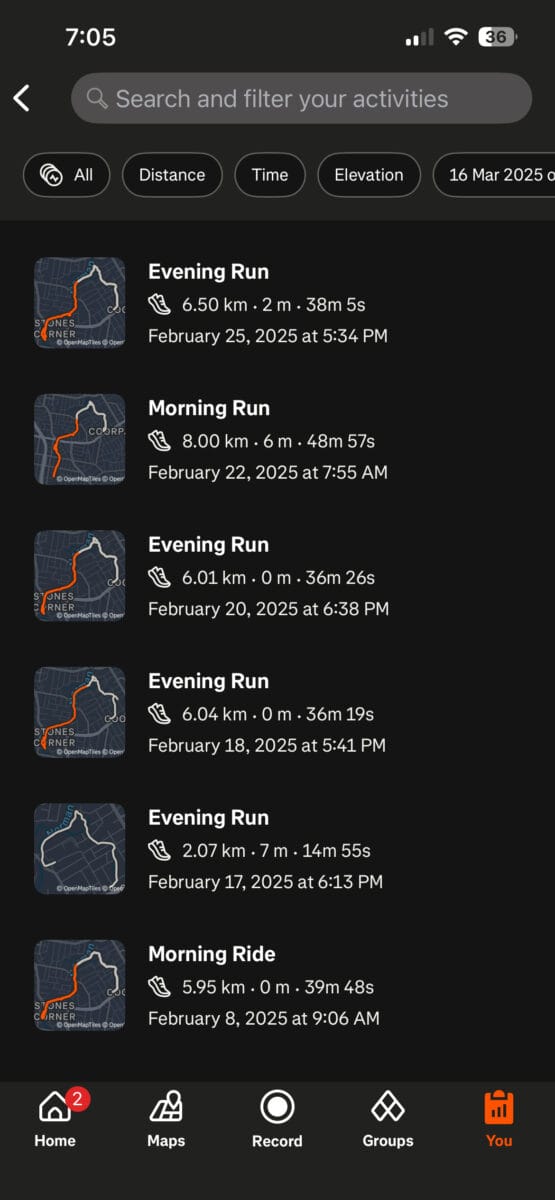
Figure 1: Early running exposures
Jane presented to the clinic in late September. She had already ran 3 half marathons and in late July after completing her second half marathon, she had developed foot and knee pain. She noticed the pain routinely thereafter following her 8-10km runs, however, it became severe enough after a 10km event in mid-September, that she decided to seek Sports Physio advice. The graph below shows her mileage along with the timings of her half marathon events (H1-H4).
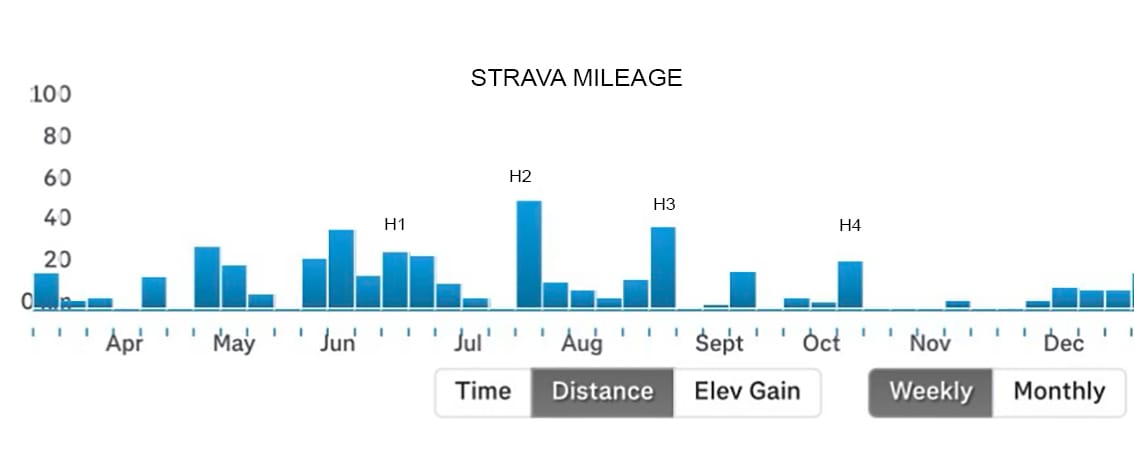
Figure 2: Extrapolated running mileage Year 1 and Half Marathon events
Some simple analysis of this information did raise an eyebrow at the time of consultation. There are some novice mistakes she made that we have previously touched on with respect to her approach to training.
Starting keen
Looking at some of her early runs (fig. 1) she totalled 22.12km in 6 days. This probably isn’t unreasonable mileage but again without internal load metrics it’s difficult to glean much from it. As a novice runner with very little base, however, 20+ km per week is at the high end of appropriate volume for early running exposures.
Inconsistent prep
Looking at her volume alone over the bulk of the year (fig. 2) you can see some very inconsistent loading weeks across the board. March, April and May leading in to her first half marathon in June had some quite low load weeks, so the initial start she had in February was not especially consolidated over the subsequent 2-3 months. This raises the possibility of ineffective short-term tissue adaptation.
June saw a spike in load which included the half marathon itself. There was some improved running consistency thereafter but overall volume tapered to a zero load week prior to her second half marathon less than a month later in July. Further running that race week spiked her volume to a 40+km run week, which is where pain was first encountered.
Load spikes, pain spikes
Despite being in pain, Jane persevered in her ambition to complete her remaining half marathons. A fraction more than one month since the second saw her complete her third, significantly spiking her mileage. Without much consistent preparation, Jane ultimately completes three half marathons not much more than 2 months apart. Unfortunately, by now the pain is too great to continue and running volume has to reduce dramatically. From here, a volume dip is consolidated leading in to a 10km event in September. Feeling improved off some relative rest and thinking 10km is a much easier task she continues to run. By the end of this run, the pain is reawakened. In late September, a period of rest is advised to work on some strength fundamentals and allow the tissue stress to settle.
Win at all costs
Jane set herself a goal; 4 half marathons. Despite having had some Physiotherapy intervention and advice, she is determined to complete her goal and a 4th Half Marathon is undertaken in October. Not surprisingly, it’s her slowest time, some 27 minutes off her best, with pain and discomfort featuring prominently. Individual sports do require a level of self-discipline and determination, but some of the character traits that make you a successful athlete, can also run you in to more trouble. By the end of October, it’s time to rest, reflect, reorganise and plan for a resumption of training that lends itself to a less interrupted lead in to 2026.
How we fixed it: Structured load progression in practice
On top of engaging in some prescribed strength and conditioning exercises, adjustment to the running schedule was required. Consistent, safe load progressions were adopted with more careful monitoring of week to week increases.
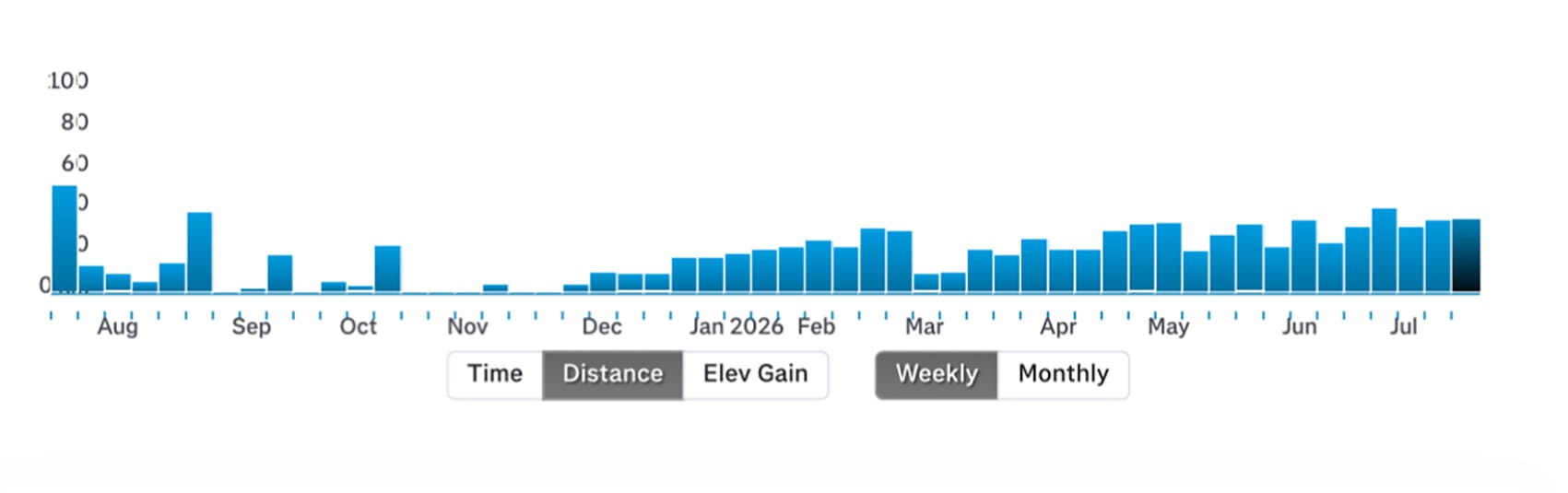
Figure 3: Year 1 inconsistency – Year 2 consistency
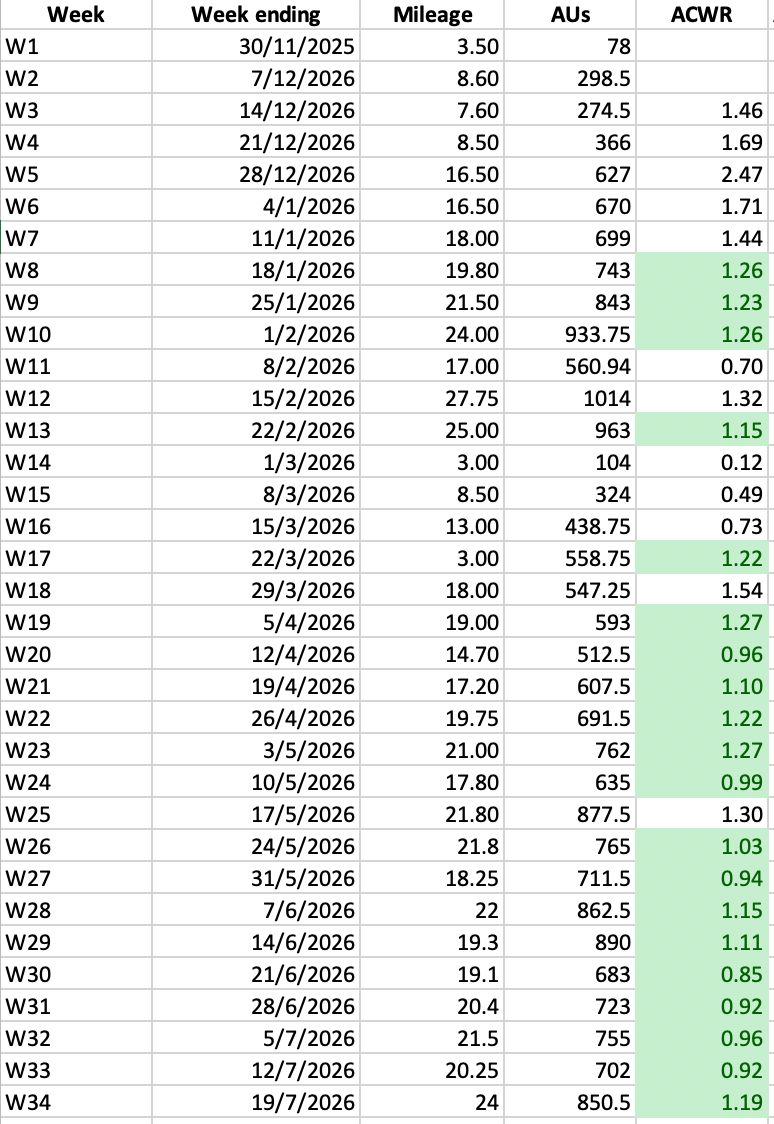
Table 1: Rolling ACWR Values
Monitoring Acute: Chronic workload ratio is not an easy thing to do. It requires some meticulous data entry (for now). Ultimately, what has been able to be achieved and as evidenced in figure 3. is some steady volume accumulation by way of thoughtful load progression. It is this training philosophy that enables tissue adaptation and load tolerance to occur. What is not captured by this graph is that Jane was able to keep running and building volume with some low-level discomfort, up to a 2/10 mainly in one knee. It is much more necessary to monitor load in this situation, since the athlete is training close to her ceiling, potentially even at times exceeding it. A training floor and ceiling is something we will discuss in later blogs, but looking at the ACWR values in Table 1, you can see more consistent values in the training sweet spot, whilst overall volume is slowly increasing. Additionally, if you look at similar mileage weeks; Wk 9, Wk 23 and Wk 32 (all around 21km weeks), we can see a trend downwards in her Arbitrary Units (AU), indicating that this amount of ‘work’ is getting easier (her internal load scores are diminishing).
Key Take-aways from Part II:
Injuries occur when load exceeds an athletes’ capacity to withstand it. As we see regularly in our Brisbane Sports Physiotherapy clinic, these injuries are almost always preventable with the right understanding and training approach.
Tracking mileage alone (external load metric) is not predictive of injury. You must consider the cost of that load, and this is highly individual (internal load metrics), but it is closely related to running experience.
However experienced a runner you are, the majority of your runs (70-80%) should be easy, with a rating of perceived exertion (RPE) around a 2-4/10 (i.e. you can hold a conversation).
An acute: chronic workload ratio of 0.8-1.3 is a sweet spot for load progression. A value above or below this could be a trend towards overtraining or undertraining respectively.
Running with a low level of pain is OK providing you are keeping careful tabs on the pain itself, are monitoring both internal and external load metrics and as well are doing conditioning work and corrective exercise as you go. A trend upwards in load tolerance and downwards in pain levels is the goal.
FAQ:
Q1: What is acute to chronic workload ratio (ACWR)?
A: The ACWR compares your current weeks training load to your four week average. A ratio between 0.8 – 1.3 is generally the safe zone. Above 1.3 suggests you may be increasing your load and progressing too fast. Below 0.8 is either deloading or detraining and sustained low ACWR values may not support tissue adaptation.
Q2: How much should a beginner runner run per week?
A: A true beginner might safely start with 5-10km per week, building gradually over several months to 15-30km. Rushing this is one of the most common causes of injury.
Q3: Why does my knee hurt after running?
A: There are a number of factors that can influence the onset of knee pain following running. Broadly, these are 1) environmental factors, such as the surface you are running on (hard/soft) or the terrain (cambered/flat) and elevations (hills) amongst others. 2) Equipment related, including how appropriate your footwear is. 3) Biomechanical factors, which include neuromuscular control and stability and lastly 4) Training errors, which include all the elements we have discussed; mileage, intensity, frequency etc. A sports physiotherapy assessment helps tease out which elements are mostly contributing to the knee pain and implements corrective strategies to address it.
Q4: What percentage of runs should be easy?
A: Around 70-80% of your runs should be easy (at an intensity of 2-4/10) where you can comfortably hold a conversation. This lets your body accumulate volume and adapt to it appropriately without causing excessive tissue stress.
If you need help with recovery from a running injury or need assistance building a safe training plan? Book your running assessment now via the bookings page.
See you in the Clinic
Chris Dillon
Chris Dillon is a titled APA Sport and Exercise Physiotherapist and the founder of Brisbane Sports Physiotherapy. He works with athletes from grass roots to the elite level with a focus on injury prevention and load management. He is a member of the Australian Physiotherapy Association (APA) and registered healthcare provider with the national body AHPRA.